
Most lists of pulse survey questions are terrible. You've seen them: a PDF with 50 generic questions, half of which are duplicates, none of which tell you what to do when a score comes back low.
This isn't that.
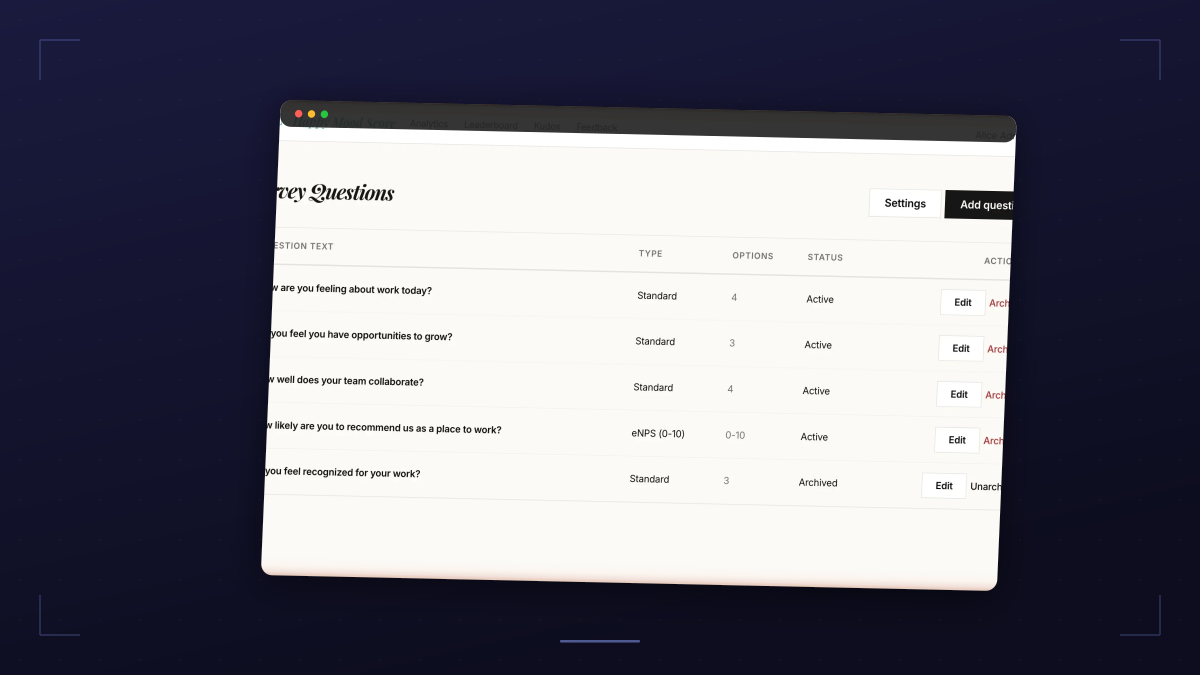
What follows is 15 carefully chosen pulse survey questions, organized by what they actually measure. For each one, you'll know what a low score is telling you and what to do about it. You can start using these this week.
Why fewer questions get better answers
Before the list, a quick word on volume -- because the instinct when you start is to ask everything at once.
Shorter surveys get dramatically higher completion rates. Research consistently shows that pulse surveys with one to three questions get the highest response rates -- often above 85%. Add more questions and that number drops fast. People have things to do, and the moment a survey feels like work, they close the tab.
The best practice is one to five questions per pulse, not 15 at once. The 15 questions in this article aren't meant to be sent in a single survey. They're a rotation. Pick two or three per week, cycle through the dimensions over a few weeks, and you'll build a complete picture without burning anyone out.
Think of it like a temperature check across five different body parts. You don't need to check all five at once -- but over a couple of weeks, you want to have checked them all.
The five dimensions of team engagement
Engagement isn't one thing. When someone quits, it's rarely because of a single bad experience. It's usually a slow accumulation of signals across a few different areas.
These five dimensions are the ones that research links most directly to retention:
- Satisfaction -- Do people feel good about their work?
- Growth -- Do they feel like they're developing?
- Leadership -- Do they trust and feel supported by the people above them?
- Belonging -- Do they feel like they're part of the team?
- Workload -- Is the pace sustainable?
If any one of these dims significantly, turnover risk goes up. Your pulse survey questions should cover all five -- just not all at once.
Dimension 1: Satisfaction
Satisfaction is your baseline. It doesn't tell you why someone's unhappy, but it's a reliable early warning system. When satisfaction scores drop and you haven't changed anything, something happened that you don't know about yet.
Question 1: How satisfied are you with your work this week?
Scale: 1 (not at all) to 5 (very satisfied)
What it measures: Overall sentiment, week to week. This is your headline number. It's not diagnostic on its own, but it's the first thing to watch.
What a low score signals: Something changed. Maybe a project got derailed. Maybe someone had a tough conversation with their lead. Maybe two people have been quietly clashing for a month. You don't know yet -- but you know to look.
What to do: Don't assume. When satisfaction dips, pair it with a qualitative question the following week ("What's one thing we could do to make next week better?") or just have a direct conversation with the team. A drop of half a point in a week is worth a quick check-in.
Question 2: How proud are you to work at this company?
Scale: 1 (not at all) to 5 (very proud)
What it measures: Connection to the company's mission and reputation. This goes beyond weekly mood -- it's about whether people feel like they're part of something they'd tell their friends about.
What a low score signals: Disconnection from the why. This often surfaces after difficult news (layoffs elsewhere in the industry, a public stumble, a strategic pivot that wasn't communicated well). It can also signal that the company's stated values and actual behavior are drifting apart.
What to do: This one calls for transparency. If something happened that rattled people, acknowledge it. Don't wait for all-hands season. A Slack message that says "I know the news this week was unsettling -- here's what I want you to know" goes further than you'd expect.
Question 3: How likely are you to recommend this company as a great place to work?
Scale: 1 (very unlikely) to 5 (very likely)
What it measures: This is your internal eNPS proxy. It's a leading indicator of retention and referral behavior. People who score this high tend to stay longer and bring in other good people.
What a low score signals: Either they wouldn't stay if they had an offer, or they wouldn't stake their reputation on sending someone here. Both are serious. A team that scores consistently low here is a team where someone is quietly interviewing.
What to do: Don't address this question in isolation -- look at which other dimension scores are dropping alongside it. Low satisfaction plus low pride plus low recommendation scores is a pattern that needs a full conversation, not a ping-pong table.
Dimension 2: Growth
Growth is the most underrated retention factor. People leave managers, yes -- but they also leave when they feel like they've stopped learning. For ambitious people at growing companies, stagnation feels like falling behind. You need to catch it early.
Question 4: Do you feel like you're learning and growing in your role?
Scale: 1 (not at all) to 5 (absolutely)
What it measures: Whether people feel challenged and developed. This is especially important in the first year of someone's tenure, and again around the two-year mark when roles can start to feel comfortable-but-flat.
What a low score signals: People are either under-challenged (the work has become routine), over-challenged without support (they're drowning, not growing), or they don't see a path forward. You need to figure out which one.
What to do: Have a direct conversation about development. Ask: "What would make you feel like you're growing in this role?" Some people want new projects. Some want to level up into management. Some want dedicated learning time. You can't guess -- you have to ask.
Question 5: Do you have clear opportunities to advance your career here?
Scale: 1 (not at all) to 5 (yes, clearly)
What it measures: Whether the road ahead is visible. You can love your current work and still leave if you can't see where you're going in six months. This question surfaces that.
What a low score signals: Either career paths aren't defined, or they exist but weren't communicated, or they were communicated once and people forgot. At fast-growing companies, this gap is surprisingly common -- you're moving so quickly that nobody has sat down to map out what "senior" or "lead" actually means.
What to do: Document and share your career ladders. If you don't have them, build them -- even rough ones are better than nothing. Host a 30-minute session where people can ask questions. A clear path, even if it's slow, is more comforting than an opaque one.
Question 6: In the past month, have you had a chance to do work that plays to your strengths?
Scale: 1 (not at all) to 5 (all the time)
What it measures: Strengths utilization. People who get to use their best skills regularly are more engaged, more productive, and far less likely to leave. This question is different from general satisfaction -- someone can be satisfied with their job while still feeling like their best skills are going to waste.
What a low score signals: Misalignment between what someone's good at and what they're actually doing. This is fixable, but only if you know about it. It often comes from role drift -- someone hired for one thing slowly inherits tasks they're not energized by.
What to do: Have a 1:1 conversation specifically about this. Ask people to name their top two or three strengths. Then look honestly at what they actually spend their time on. If there's a gap, find ways to close it -- even small adjustments make a difference.
Dimension 3: Leadership
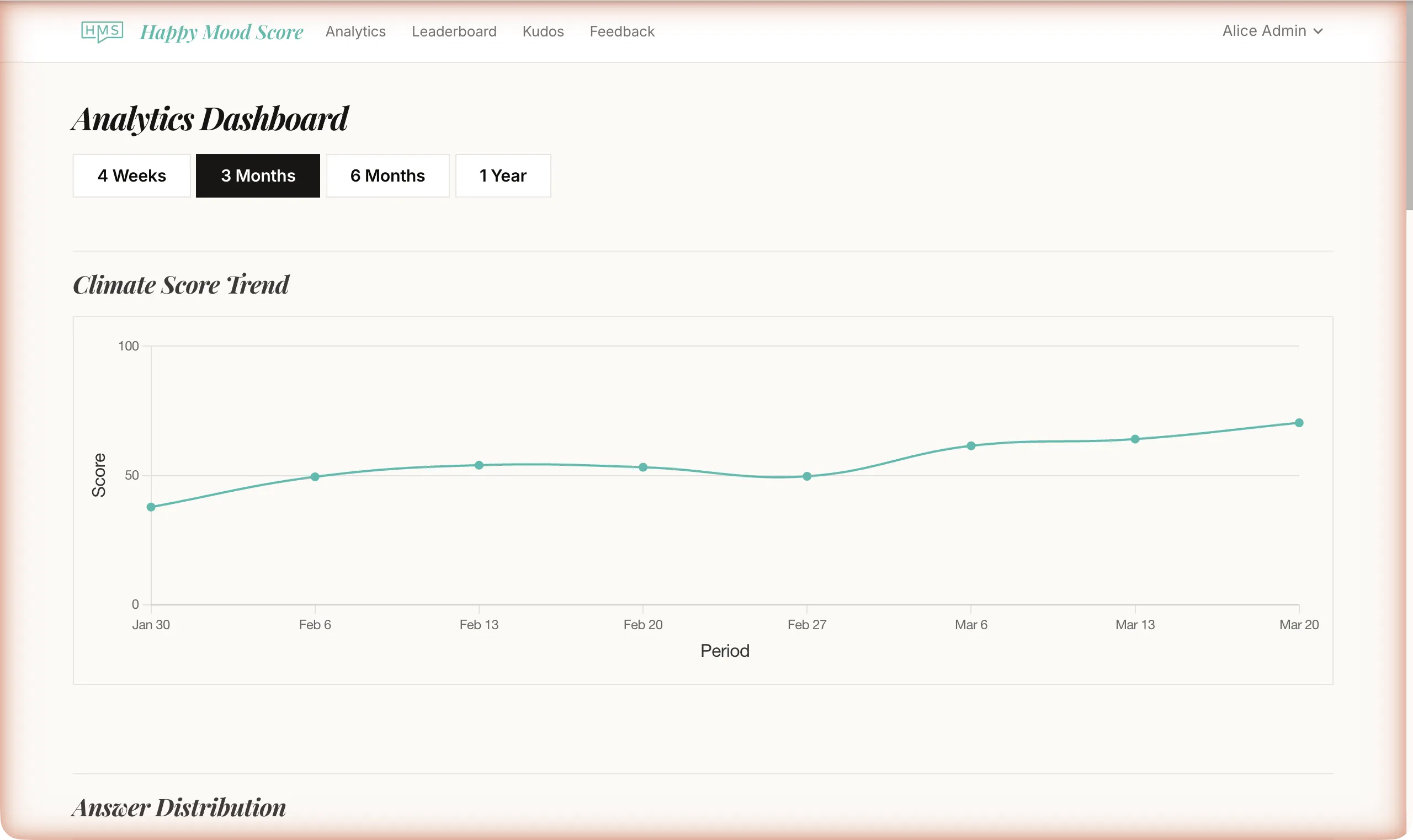
People don't leave companies, they leave managers. You've heard that. What pulse surveys let you do is measure it specifically and consistently, so you're not finding out at an exit interview.
This is the dimension that feels most uncomfortable to ask about, and the most valuable.
Question 7: How supported do you feel by your direct manager?
Scale: 1 (not at all) to 5 (very supported)
What it measures: The quality of the most important relationship at work. Every other engagement score is influenced by this one. When this drops, everything else tends to follow.
What a low score signals: A breakdown somewhere in the manager-employee relationship. It might be communication frequency, unclear expectations, lack of recognition, or something more serious. You won't know without digging in.
What to do: Don't confront the manager with raw data. First, look at whether it's team-wide or isolated to one or two people. Then have a coaching conversation: "Support scores on your team dropped this month -- what's your read on that?" Give them a chance to identify the issue themselves.
Question 8: Does leadership communicate openly and honestly with the team?
Scale: 1 (not at all) to 5 (absolutely)
What it measures: Trust in communication from above. This is about the whole leadership layer, not just direct managers. When people feel like they're not getting the full picture, anxiety and rumor fill the gap.
What a low score signals: People feel like information is being withheld, filtered, or delivered too late. This is particularly common during periods of change -- reorgs, pivots, budget tightening. When leadership goes quiet, teams assume the worst.
What to do: Increase communication frequency, not just quality. You don't have to share everything, but you do have to share something regularly. A short "here's what leadership is focused on this week" update does more for trust than a polished all-hands every quarter.
Question 9: Do you feel that your work is recognized and appreciated?
Scale: 1 (not at all) to 5 (yes, regularly)
What it measures: Recognition culture. This isn't about bonuses or perks -- it's about whether the everyday work gets seen. Recognition has an outsized effect on belonging and satisfaction, and it's one of the cheapest things to improve.
What a low score signals: Either recognition isn't happening, or it's happening privately when people also want it to be public, or a few people are getting all the praise while others feel invisible. On remote teams, this problem is more common because good work is less visible.
What to do: Build recognition into your weekly rhythms. A dedicated Slack channel, a standing "shout-outs" segment in your weekly sync, or a simple "what went well" section in your retrospectives. It doesn't need to be elaborate -- it needs to be consistent.
Dimension 4: Belonging
Belonging has become a buzzword, but the underlying thing it measures is real and important: do people feel like they're genuinely part of the team? At growing companies, this is especially fragile. Fast hiring can create in-groups and out-groups without anyone intending it.
Question 10: Do you feel like you belong on this team?
Scale: 1 (not at all) to 5 (completely)
What it measures: Psychological safety and inclusion. This is the foundational question for belonging. It's different from job satisfaction -- someone can love their work and still feel like they don't quite fit.
What a low score signals: Social exclusion, whether deliberate or accidental. It can show up in small ways: not being included in informal conversations, feeling like an outsider in team jokes, or sensing that decisions are made in rooms they're not in. New hires and remote employees are especially vulnerable.
What to do: Look at the data by tenure and by team. Are new hires scoring lower? Are remote employees? That tells you where to focus. Social connection requires deliberate effort -- it doesn't happen automatically.
Question 11: At work, do you feel comfortable being yourself?
Scale: 1 (not at all) to 5 (completely)
What it measures: Psychological safety. This is the degree to which people feel safe being honest, making mistakes, and showing up as a whole person rather than a performance of what they think they should be.
What a low score signals: A culture where people are masking -- editing themselves, holding back ideas, afraid to admit when something's wrong. Teams with low psychological safety don't surface problems early, which means those problems get expensive.
What to do: Model it from the top. Leaders who admit mistakes, share doubts, and ask for help create permission for others to do the same. This is a culture shift, not a process fix -- it takes time and consistency.
Question 12: Do you feel connected to your teammates?
Scale: 1 (not at all) to 5 (very connected)
What it measures: Social cohesion. Are people actually building relationships at work, or just shipping tasks in parallel? Connection predicts collaboration, retention, and how well teams handle pressure.
What a low score signals: Isolation. This is especially acute on remote and hybrid teams, and it tends to spike during high-output periods when everyone has their head down. It's also common after a growth spurt -- new people joined, the culture diluted a bit, and nobody's had time to rebuild it.
What to do: Create low-stakes spaces for people to interact. Not mandatory fun -- optional connection. Virtual coffee rotations, an off-topic Slack channel that actually gets used, or a 15-minute "show and tell" in your weekly sync. Small, consistent touchpoints add up.
Dimension 5: Workload
Burnout doesn't announce itself. By the time someone says "I'm burned out," they've been running on empty for weeks or months. Workload questions are your early warning system -- and they're the ones most likely to show you a preventable crisis.
Question 13: How manageable is your workload right now?
Scale: 1 (completely overwhelming) to 5 (totally manageable)
What it measures: Immediate capacity. This is your most time-sensitive question. A drop here means someone is struggling right now, not six months ago.
What a low score signals: Too much on the plate -- either too many projects, unclear priorities, or scope that wasn't accounted for in planning. Sometimes it signals inefficiency (meetings eating up deep work time). Sometimes it's just genuinely too much work for the headcount.
What to do: Act fast. A quick "what's blocking you, and what can I take off your plate?" conversation can head off a serious problem. Look at sprint scope, meeting load, and whether priorities are clear. If workload scores are low across the whole team, you have a capacity problem, not an individual one.
Question 14: Do you feel like you can disconnect from work outside of working hours?
Scale: 1 (never) to 5 (always)
What it measures: Work-life boundaries and always-on culture. This is a leading indicator of burnout that's distinct from in-the-moment workload. Someone can have a manageable number of tasks and still feel like they can never actually switch off.
What a low score signals: An implicit culture of always-on availability, usually modeled from the top. If leaders send Slack messages at 10 PM, people feel like they should respond. If vacation days get commented on, people stop taking them. The behavior you model sets the norm.
What to do: Audit your own communication habits first. Set clear expectations about response times. Encourage people to block out focus time. If you're in a culture where "always on" is a badge of honor, this takes time to shift -- but it starts with you making it explicitly not a badge of honor.
Question 15: Do you have enough time for focused, deep work in your average week?
Scale: 1 (never) to 5 (almost always)
What it measures: Meeting and interruption overhead. This one is particularly relevant for engineering, design, and writing roles where focus time is the core resource. If that time keeps getting fragmented, output quality drops and frustration climbs.
What a low score signals: Too many meetings, too many Slack interruptions, or poorly structured workdays that make it hard to get into flow. People often don't raise this directly because "I need fewer meetings" sounds like a complaint.
What to do: Do a meeting audit. Add up how many hours per week each person is in meetings. Anything above 25-30% is worth examining. Consider introducing no-meeting mornings, maker schedules for technical roles, or async communication norms that reduce the pull to be always available.
How to rotate these questions without causing survey fatigue
Now that you have 15 questions, here's how to use them without turning every Monday into a survey marathon.
Week 1: Two questions from satisfaction. Week 2: Two questions from growth. Week 3: Leadership questions. And so on. After eight weeks, you've covered everything twice and you have enough trend data to be genuinely useful.
A few rules to keep it sustainable:
Never send more than three questions at once. One to two is even better. Completion rates stay high, responses stay honest, and people don't start dreading Monday.
Keep a consistent send day and time. People are creatures of habit. Monday at 9 AM works well for most teams -- they're fresh, they're setting up the week, and the data is ready for you to act on by Wednesday.
Rotate question phrasing occasionally. The same exact question every month can start to feel like a test with a known right answer. Small variations ("How's your workload this week?" vs. "How sustainable is your pace right now?") keep the answers genuine.
Don't survey during crunch. If your team just shipped a major release or survived a rough sprint, let them breathe for a week before sending. Scores will be skewed, and you'll have better data when people aren't running on fumes.
One more thing before you start
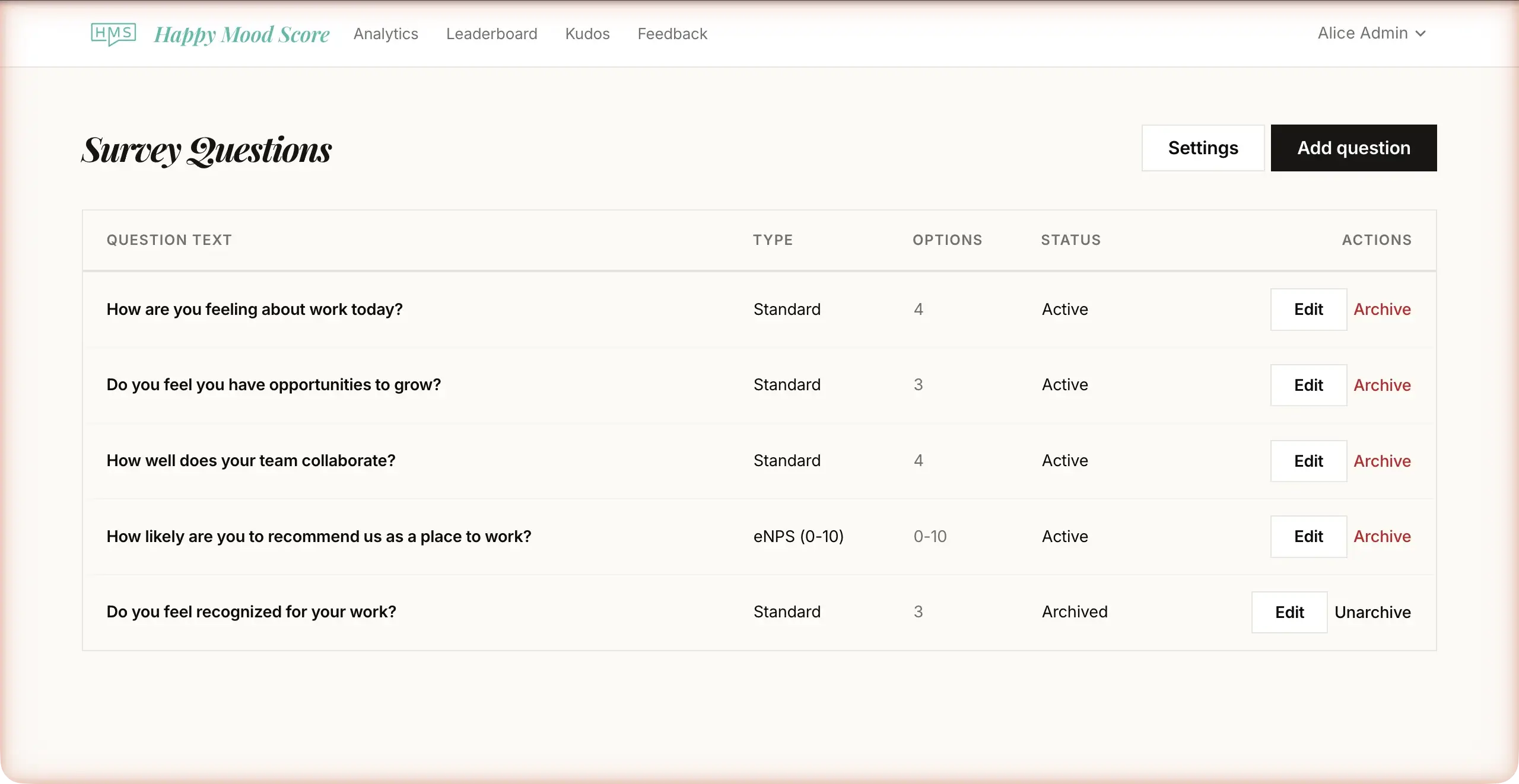
You don't need to write all these questions from scratch or worry about getting the phrasing exactly right. Happy Mood Score ships with a library of research-backed questions organized by dimension, so you can pick and rotate without the homework. But the framework above works regardless of what tool you use.
The questions matter less than the commitment to act on the answers. A 3-question survey that leads to one visible change is worth ten times a 15-question survey that goes into a dashboard nobody opens.
Start with one dimension. Send two questions this Monday. See what comes back.